
The construction sector plays a critical role in the economic and social development of countries. However, projects carried out using traditional methods often face inefficiencies, cost overruns, and communication problems. This is where BIM (Building Information Modeling) comes into play as a central concept in the digitalization of the construction industry. But is BIM truly understood, or is it merely seen as a “3D modeling tool”?
In this article, we will address the key questions necessary to grasp the essence of BIM:
- What is BIM and what is it not?
- Why is the relationship between Project Management and BIM important?
- How should concepts like Digital Twin and Asset Management be integrated into BIM?
- Why is the construction sector slower in digital transformation compared to other industries?
- How does BIM play a role throughout the lifecycle of buildings?
1. What is BIM? Why Understanding Its Essence Matters
BIM is a process and data management methodology that enables digital management of a building’s entire lifecycle (design, construction, operation, maintenance). Yet in the industry, BIM is often limited to “3D modeling.” In reality, BIM also means:
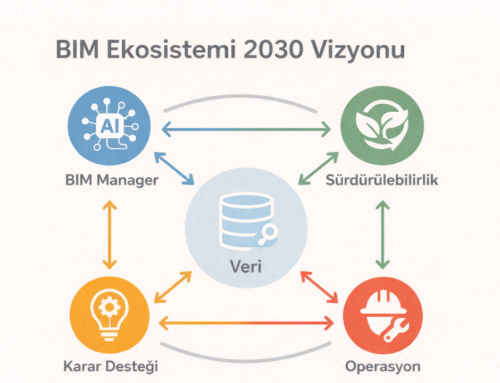
- Data-driven decision making
- Integrated collaboration among stakeholders
- Optimization of cost, time, and quality
Question: Does seeing BIM only as software (Revit, Navisworks) prevent us from understanding its true essence?
2. Project Management and BIM: An Inseparable Relationship
Understanding Project Management terminology is essential before talking about BIM, because BIM is a digital extension of project management.
How BIM Intersects with Project Management:
- Scope Management: Integrated modeling of all disciplines
- Time Management: 4D BIM for simulating the construction process
- Cost Management: 5D BIM for real-time budget tracking
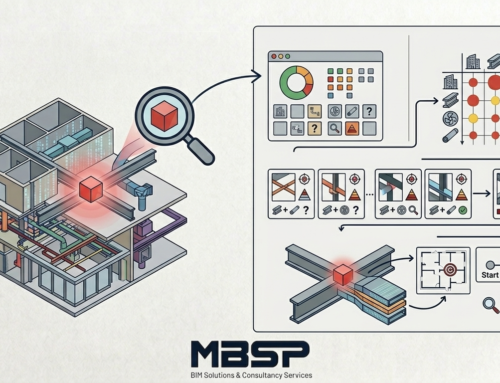
- Quality Management: Clash detection
- Stakeholder Management: All parties work on a single dataset
Question: If we ignore project management principles when implementing BIM, are we just producing “visually appealing 3D models”?
3. Digital Twin, Asset Management, and Other Concepts: How They Relate to BIM
Commonly discussed concepts in BIM include:
- Digital Twin: A real-time digital replica of the physical building
- Asset Management: Maintenance and improvement throughout the building’s life
- Value Engineering: Cost-effective design optimization
These concepts are not new, but BIM makes them implementable. For example, the automotive industry has been using digital twins for years. Why is the construction sector so behind?
Question: When adopting BIM, do we treat these concepts as “trendy buzzwords” or do we integrate them into our workflows?
4. Why the Construction Sector Is Slow in Digital Transformation
- Attachment to Traditional Methods: “We’ve always done it this way” mentality
- Lack of Training: BIM limited to software education
- Stakeholder Misalignment: Architects, engineers, contractors, and owners have different expectations
- Short-Term Focus: Focusing on upfront costs instead of long-term benefits
Question: Do we need patience to see BIM’s benefits, or is the “immediate results” culture of the industry holding us back?
5. BIM and the Lifecycle of Buildings
Will a hospital still serve the same function 50 years later? Could a mall be converted into a university? BIM answers these questions by increasing building flexibility:
- Design Stage: Modular and adaptable architecture
- Construction Stage: Materials and systems designed for future changes
- Operation Stage: Smart building management with sensors and IoT
Question: When we discuss BIM, are we thinking about the “lifetime value” of the building, or just aiming to “finish construction”?
6. Solution: Understanding the Essence and Building a System
- Training: Teach BIM as a project management methodology, not just a software course
- Stakeholder Alignment: Tailored BIM training for each role (architect ≠ contractor ≠ owner)
- Corporate Culture: Management support is crucial for change
Question: To adopt BIM, do we need to solve “communication problems” first?
Conclusion: BIM Is Not a Tool, It’s a Mindset
BIM is the digital future of the construction sector. To succeed:
✔ Understand its essence (BIM ≠ 3D modeling)
✔ Integrate it with project management disciplines
✔ Involve all stakeholders in the process